
Start a Snellville Residents Directory Search
A search works best when it begins with the one fact already known. A street address points first to the Gwinnett property roll and GIS. A personal name can be checked in the deed index, court gateway, business register, or a historical name index. An old household calls for tax digests, census schedules, newspapers, school lists, and archive files. Snellville is a city inside Gwinnett County, so many of the strongest rolls are held by county offices in Lawrenceville rather than by City Hall.
No official source is a complete household list. The assessor names owners, not every occupant. Voter material concerns registered voters and protects certain fields. Deeds name parties to a transaction, while a mailing address may differ from the property address. Treat each match as a lead until a second source agrees.
- Search the Gwinnett property roll by owner, street address, or parcel.
- Use Georgia My Voter Page when checking your own registration with the required identity details.
- Follow owners and legal descriptions into the GSCCCA Real Estate Index.
- Use Gwinnett Courts, probate, or a historical collection when the question calls for them.
- Request a specific existing record from its custodian when no online index answers the question.
The Offices Behind Snellville Resident Rolls
Custody follows the record, not the postal city on an envelope. The Gwinnett Board of Assessors maintains parcel and ownership information. The Clerk of Superior Court records deeds, liens, plats, trade names, and related filings. Gwinnett Elections maintains the authoritative voter record. Snellville City Hall keeps records created by city departments, including council, planning, zoning, permit, and occupational-tax material. A city request makes sense only after confirming that the address is inside the incorporated boundary.
Gwinnett County Elections
County registration and precinct records
Lawrenceville, GA
Read the Snellville Property Roll First
The Gwinnett assessor search is the most useful first stop for a modern address. It accepts owner, parcel, and address clues, and a parcel card can distinguish the situs address from the owner's mailing address. It can also expose the parcel identification number, legal description, assessed values, sale history, and a homestead indicator. Those fields organize a search, but they do not prove that every owner lives at the parcel or identify renters and other household members.
| Search clue | Use in the portal | What to record |
|---|---|---|
| Owner name | Find parcels titled to a person or entity | Name form and every matching PIN |
| Property address | Locate the situs parcel | Street form, municipality, and ZIP |
| Parcel ID | Return to one exact tax parcel | PIN and legal description |
| Map selection | Check adjacent parcels and boundaries | Nearby PINs and mapped layers |
Key terms. A roll is an official list kept for a public task. An index points to a record. A parcel is a mapped unit of land. A criss-cross directory arranges older entries by address or telephone number.
Follow Snellville Names into Gwinnett Deeds
The GSCCCA Real Estate Index carries statewide deed-index coverage from at least January 1, 1999, with older digitized material added by county. Search modes include party, property, book and page, date, instrument type, and county. Results can supply the grantor, grantee, filing date, instrument, and deed-book reference needed to request or view the recorded image. Account level can affect image access, so the clerk's public counters remain a practical fallback.
Gwinnett's deed trail has a sharp historical boundary. A courthouse fire destroyed former real-estate records, and the surviving clerk series starts September 26, 1871. A chain that reaches that date must be reconstructed from land grants, lottery material, tax digests, probate, court minutes, family papers, and later deeds that recite earlier title. That loss is a fact of the collection, not merely a missing web page.
The clerk explains that cutoff and its land-record services on the Gwinnett deeds and land records page.
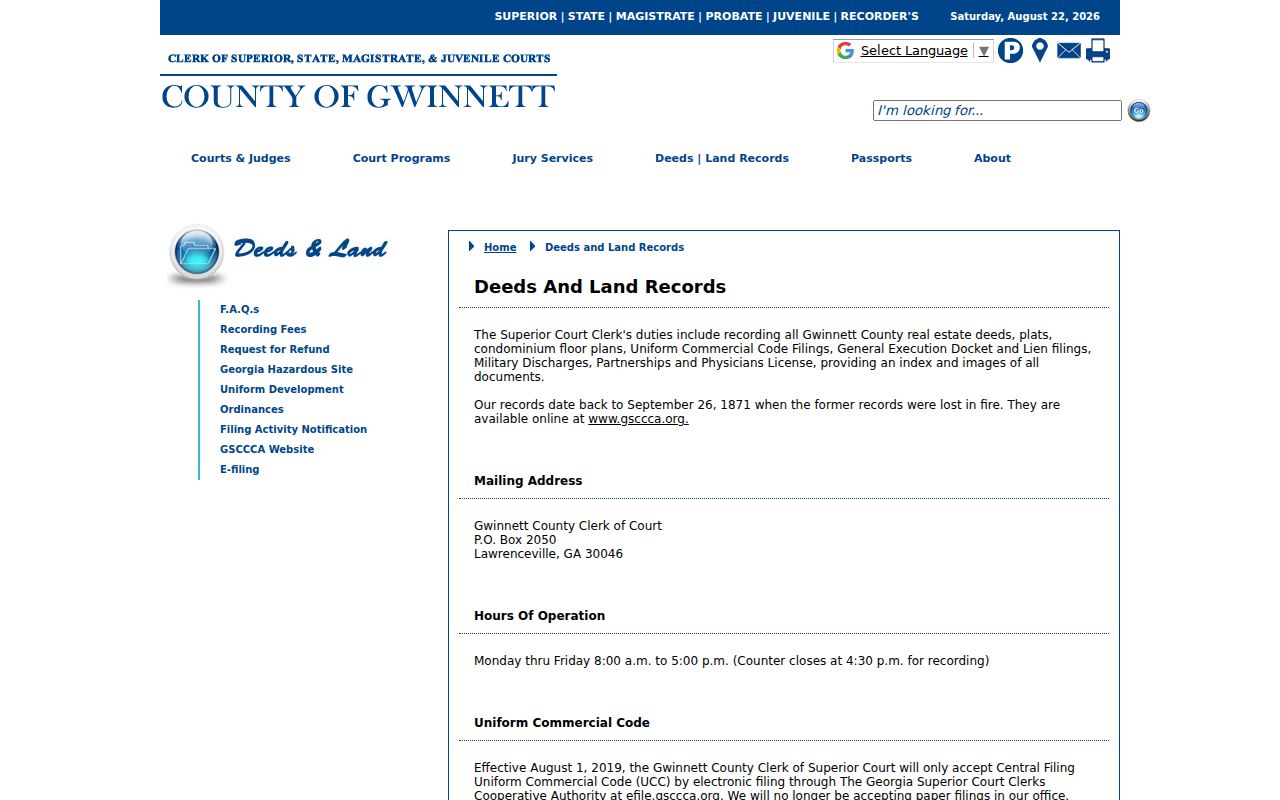
That office page is the in-person fallback when an index entry needs an official copy or older book review.
The source page for the image below is the GSCCCA Real Estate Index.
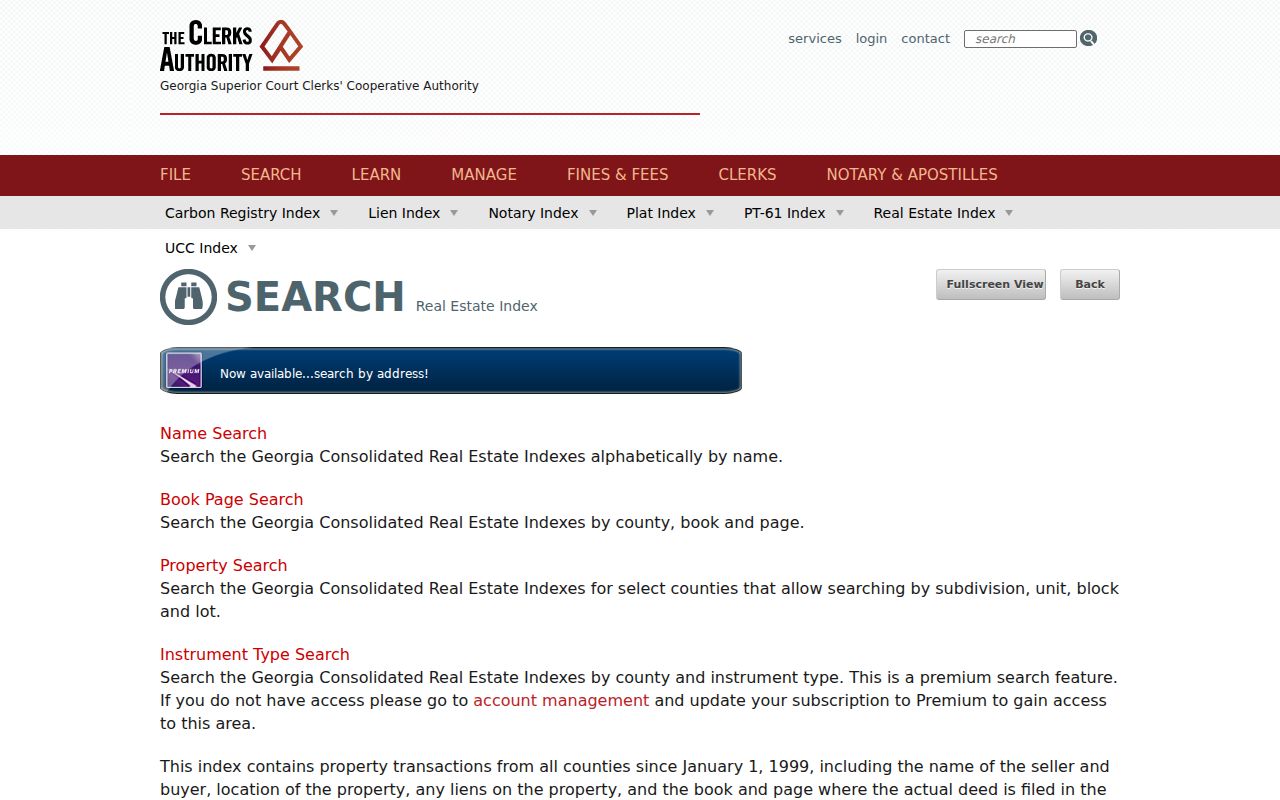
The index is the bridge between a resident name or parcel clue and the clerk's official deed image.
Current Sources in a Snellville Residents Directory
Modern resident research is a comparison of narrow official lists. Each list exists for a different civic purpose and proves only what its fields say. The Snellville residents directory therefore starts with the source best matched to the question, then tests the result elsewhere.
| Official source | People or parties shown | Custodian | Access route |
|---|---|---|---|
| Property roll | Parcel owners and mailing contacts | Gwinnett Board of Assessors | Free property search |
| Voter record | Registered voters, with protected fields withheld | Gwinnett Elections | MVP self-lookup or lawful list request |
| Real-estate index | Grantors, grantees, and other filed parties | Superior Court clerk and GSCCCA | Index and account-based images |
| Court case index | Named parties and docket events | Gwinnett court clerks | Case-search gateway |
| Business and license indexes | Filed agents, officers, and licensees | Georgia Secretary of State | Free verification portals |
When the goal is to distinguish one same-name person, the Snellville resident lookup guide shows how to compare independent records without treating a loose match as proof.
What Georgia My Voter Page Can Confirm
Georgia My Voter Page is designed for a voter's own status check. It asks for first initial, last name, county, and date of birth, then can return registration status, polling place, districts, sample ballot, and absentee-ballot details. County Elections remains the authoritative custodian. A public voter list can include names and addresses under O.C.G.A. § 21-2-225, but identification numbers, Social Security data, month and day of birth, and protected addresses are withheld.
The image source is the official Georgia My Voter Page.
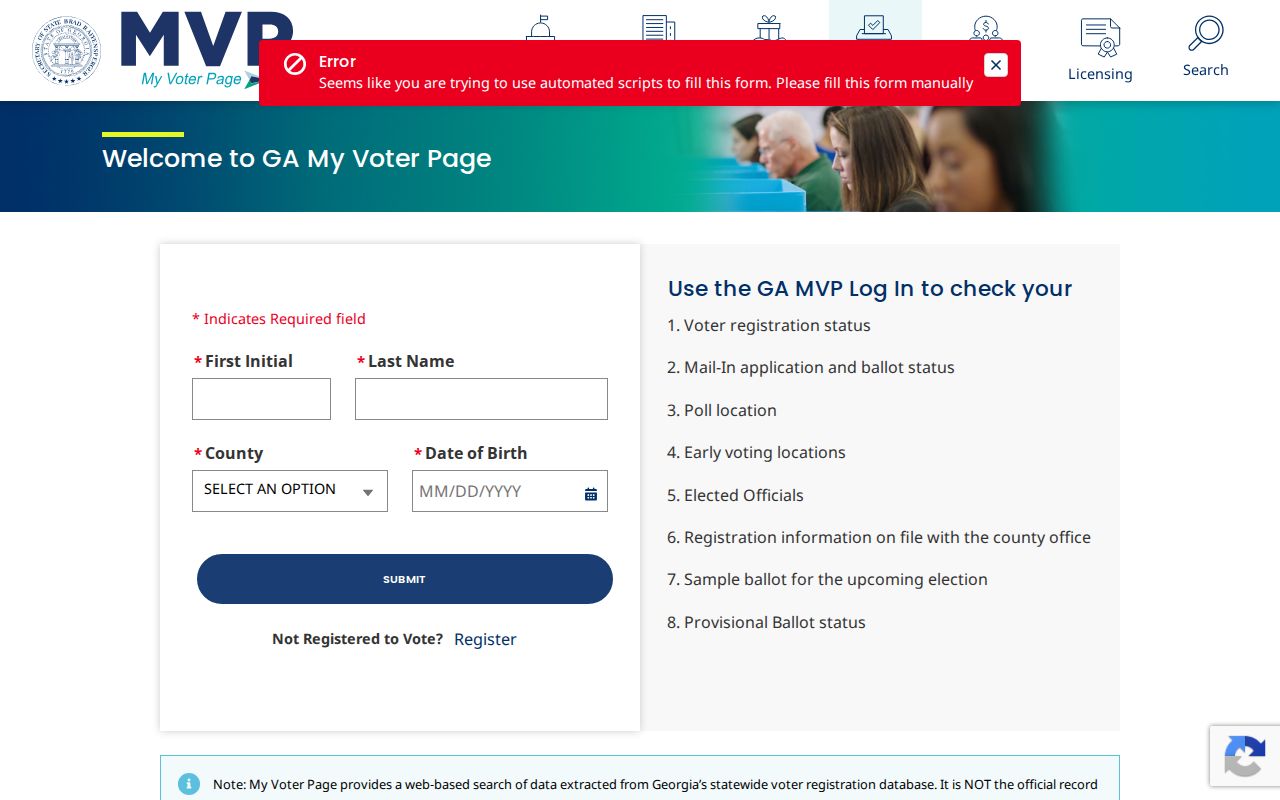
Because the form requires identity details, it is not a public browse-by-street directory and should not be presented as one.
Snellville City Records Need a Boundary Check
A Snellville mailing address does not by itself place a parcel inside the city. The county ZIP map places 30039 and 30078 around Snellville and shows 30052 touching the city area, while ZIP codes describe mail delivery rather than municipal government. Check the city zoning map or a municipal-boundary layer in Gwinnett GIS before seeking a city permit, zoning case, code file, or council record.
For a city-created record that is not already posted, describe an existing document and send the request through the Snellville open-records channel. Useful details include the department, date range, property address, permit or case number, and preferred electronic format. Georgia's Open Records Act calls for a response within three business days when records cannot be produced at once. The first 15 minutes of search, retrieval, and redaction time are free, and ordinary letter or legal copies are capped at 10 cents per page unless another fee applies.
The request route is shown on the official Snellville open-records page.
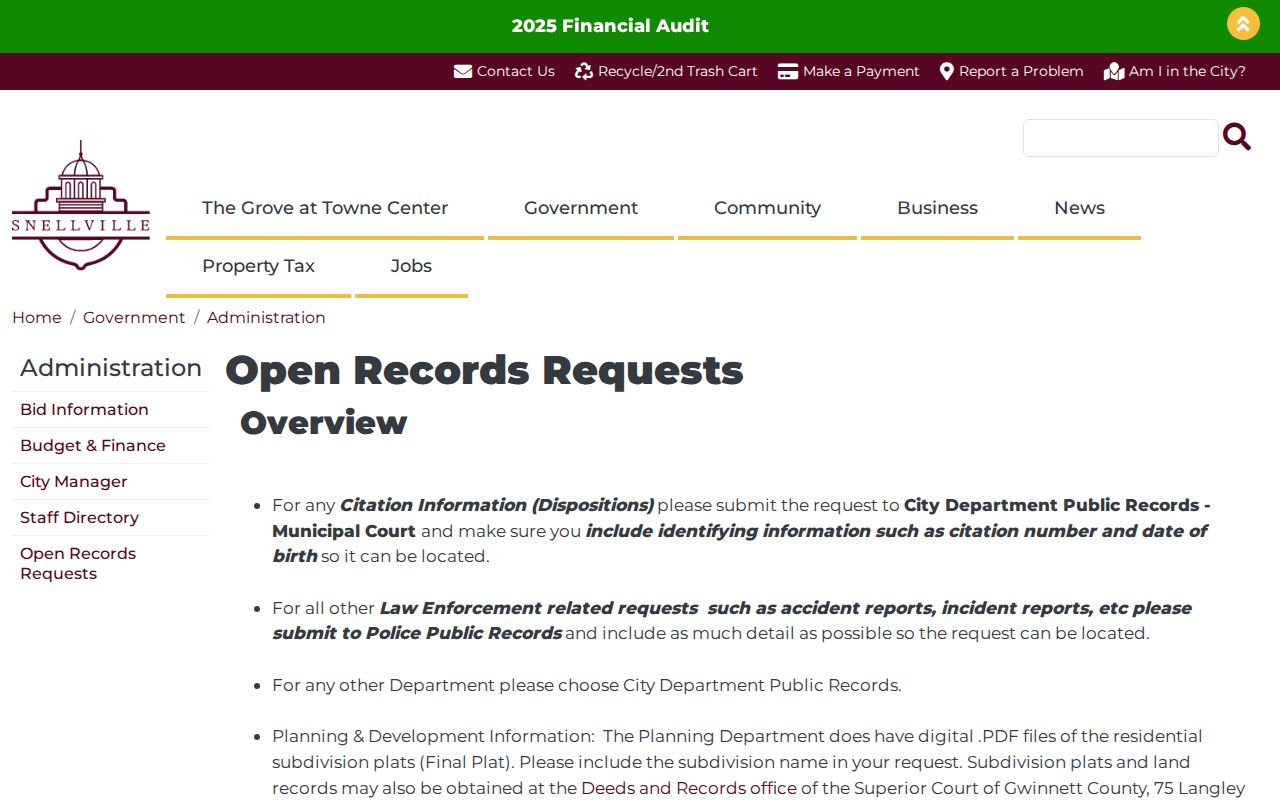
The city channel is for identifiable city-created records, not county parcel, deed, or voter files.
Compare Official Rolls with Commercial Compilations
Official portals are narrower but identify the custodian and the legal purpose of the record. A parcel card can be checked against a deed. A docket entry can be checked with the clerk. A voter status result can be confirmed with Elections. Commercial compilation tools may merge records from different dates and people, obscure the source, or retain stale addresses. They can supply a lead, but they should never outrank the original record.
Official rolls
Defined fields, named custodian, source-specific correction path, and clear limits on what a match proves.
Commercial tools
Broad aggregation, uncertain refresh dates, possible identity merging, and removal that does not alter the public source.
Use records lawfully. Public access is not permission to follow, threaten, impersonate, trespass, or harass anyone. Georgia stalking and harassing-communications laws still apply.
If personal data is misused for fraud, begin recovery at the federal IdentityTheft.gov resource.
The recovery site addresses identity theft; it is not a resident-search source.
Snellville Court and Probate Name Trails
The Gwinnett Courts gateway routes searches for Superior, State, Magistrate, and Probate estate cases, while Recorder's Court has a separate search for its assigned matters. An index result may show a case number, party names, case type, filing date, status, assigned judge, events, and dispositions. That metadata helps separate people with similar names, but an index is not the complete court file and sealed or restricted material does not become public because a portal exists.
Probate estate files can be valuable when looking for an heir or connecting relatives. Petitions, wills, inventories, notices, and orders may name decedents, petitioners, heirs, executors, and addresses. Search the estate portal, then contact Probate Court for the official file and current copy options. Certified records come from the custodian, not from a search-results screen.
The available court routes are collected at the official Gwinnett case-search gateway.
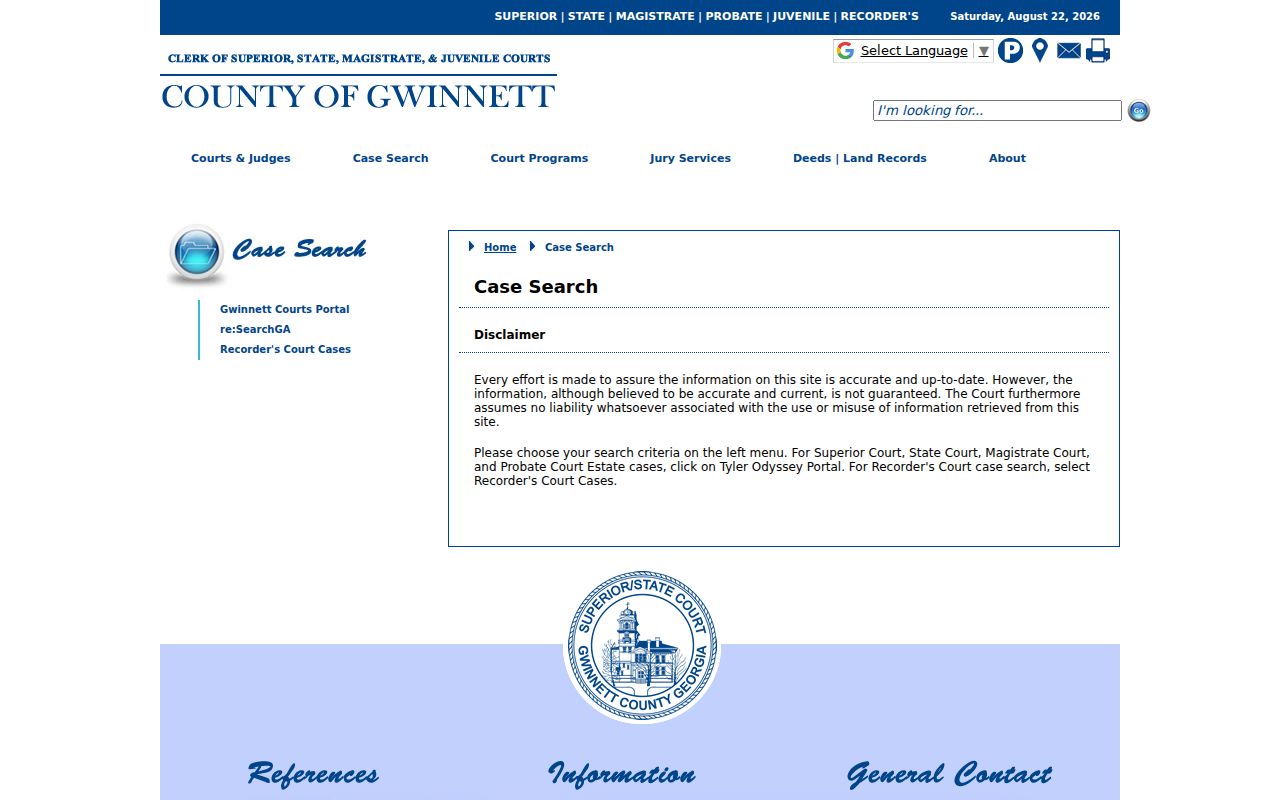
The gateway separates court categories and directs users toward the appropriate official system.
Map a Snellville Address in Gwinnett GIS
Gwinnett's GIS Data Browser can search by address, owner, street, intersection, or parcel identification number. Start with an address, select the matching parcel, and save its PIN before turning on other layers. The parcel pop-up may repeat owner, situs, legal-description, tax, and sale clues, while mapped transportation, school, utility, and municipal layers supply geographic context. Clicking neighboring parcels can build a block-level work list without assuming that every mailing label marks the city boundary.
GIS is strongest as a connector. A PIN links the map to the assessor record. A subdivision, land lot, district, or plat reference can link the parcel to deeds even when a road label changes or an old address does not autocomplete. The viewer is not proof of who occupies a home, and a school-zone layer describes attendance assignment rather than resident identity. Record the layer date when it is shown, because boundaries and mapped data can change.
The official image source is the Gwinnett GIS Data Browser page.
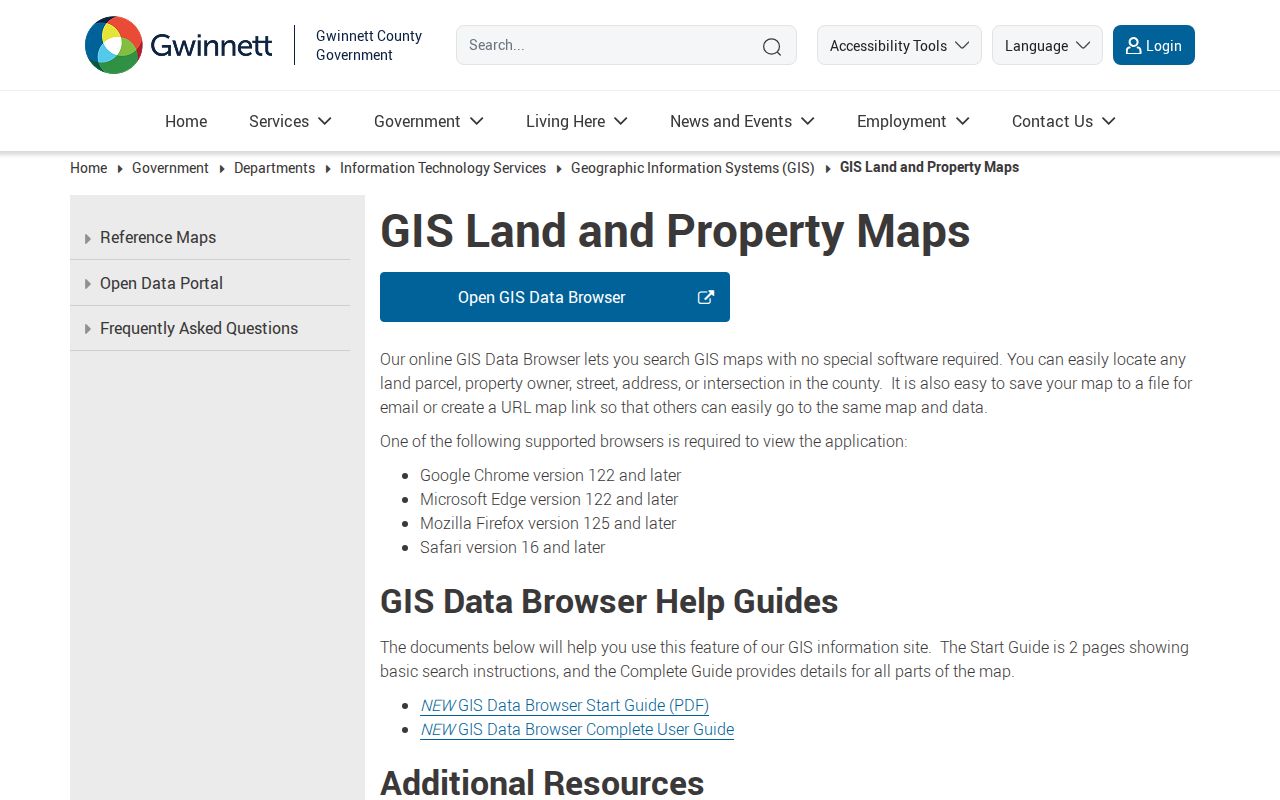
The county viewer helps determine whether the next inquiry belongs with Snellville or a countywide custodian.
Three Postal Areas Complicate Snellville Searches
Snellville research often crosses 30078, 30039, and the nearby 30052 area. Central Snellville is associated with 30078, while 30039 covers the Centerville and southern area and extends beyond the incorporated city. Loganville's 30052 touches the eastern edge. These are postal patterns, so none should be used alone to decide whether a permit, police, planning, or municipal-court record belongs to the city.
Verify the full delivery address through USPS, then place it on the county ZIP map and GIS municipal-boundary layer. Use the exact situs address and PIN in county property and deed systems. If a city-created file is needed, confirm incorporation through mapped city sources before contacting Snellville. This order prevents a postal-city label from sending a request to the wrong government.
Historical Shelves for Snellville Residents
No verified official catalog page identifies a continuous standalone Snellville city-directory run. That gap changes the method. Search suburban telephone books and reverse directories by exact title and year, then use the Gwinnett Historical Society's Rosebud-Snellville-Suwanee binder index, family files, cemetery and death records, photographs, manuscripts, and published county compilations. The society's archive operates in the Historic Gwinnett Courthouse in Lawrenceville, while Gwinnett County Public Library provides on-site Ancestry Library Edition plus HeritageQuest and news databases.
Useful companion volumes include Snellville Consolidated School, with students, teachers, photographs, and an index through 1957, and a reprint of a 1911 account of 92 Gwinnett churches with membership lists. An 1890 tax digest can help replace evidence lost with most of that federal census. Historical death certificates for 1919 through 1943 are available through FamilySearch as directed by Georgia Archives. The full shelf and entry-reading method belongs to the Snellville city directory collections.
The Snell Letters Add Names Beyond the Rolls
Official indexes reduce lives to names, dates, parcels, and case numbers. Snellville's returned family letters show why archival papers matter too. About 130 letters linked to the Snell family were preserved outside Georgia for more than a century and came to local historians' attention in 2012. They expanded the record of the Snell and Sawyer settlement period beyond what deeds and census schedules alone could reveal.
The Snellville Historical Society is the local archival organization for that community story, while the Digital Library of Georgia adds newspapers, photographs, maps, and partner collections. A careful researcher cites the letter, newspaper item, or archive file by date and collection, then tests names against deeds, tax, probate, church, school, or census sources. That combination turns a bare directory hit into a well-supported local history.